 Nate Bladecki, MPH, RD
 What is functional nutrition?
It is a way of practicing nutrition that looks at your whole system instead of one number, and works backward from what you are feeling to what is driving it. It takes more time than a single consult, and this page explains exactly where that time goes.
Functional nutrition in two minutes
Functional nutrition is nutrition care built around one person instead of one condition.
Rather than addressing a symptom on its own, it looks at how your systems work together, your digestion, hormones, energy, inflammation, sleep, and stress, and asks what is actually driving the thing that brought you here. The plan comes after that, not before.
It is not a diet, a protocol, or a supplement list. It is a process, and it is the reason two people with the same complaint often leave with completely different plans.
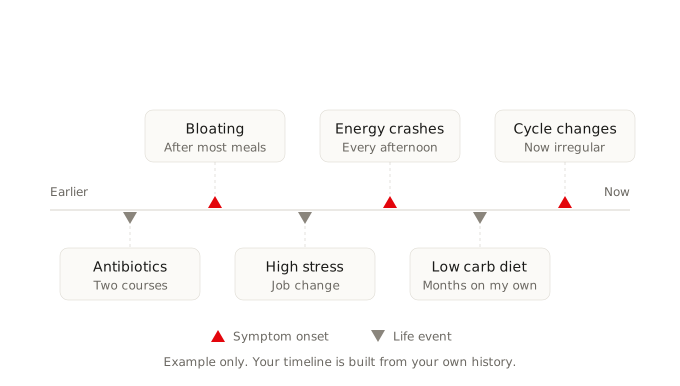
How symptoms build over time
Two different models of care
Both of these are real, legitimate ways to get help with nutrition. They are built for different situations, and it is worth knowing which one you actually need before you pay for either.
A single consult
One appointment, focused on the question you walked in with. The assessment covers your current diet, relevant history, and the concern at hand. You leave with recommendations and a clear direction to follow on your own. The plan is built once, from what is known that day. Follow up is optional and often does not happen.
This is the right choice when you need an expert answer to a specific question, you want a credible starting point, or your situation is straightforward and you are confident executing on your own. Plenty of people need exactly this and nothing more.
Ongoing functional nutrition care
It starts with a full intake: health history, symptoms, medications, past approaches, training, sleep, stress, digestion, and what you are actually after. I score your symptoms across every body system so we have a number to move, and I map when things started and what was happening in your life around that time.
Your first plan is a starting point, not a final answer. What your body does in response is information, and we use it. Labs get interpreted alongside everything else rather than read in isolation. Supplements support the plan instead of being the plan. Every few weeks the plan changes because you have changed, and at the end of a phase we re-score and re-test to see what actually moved.
This is the right choice when you have already tried the obvious things, your situation has more than one moving part, or you want the most efficient path with the least trial and error.
Lab interpretation is included with Nutrition Coaching.
That is the honest difference. A consult gives you an expert answer at one moment in time. Ongoing care gives you an expert watching what happens next and changing course when your body says to. It costs more because it is more work across more time, and because most of the value shows up in the adjustments rather than in the first plan you receive.
How I work
The steps are the same for everyone. What changes is what we find.
- 1
A real intake, not a form
The application asks about your health history, symptoms, medications, past approaches, training, sleep, stress, digestion, and what you are actually after. It is long on purpose. Alongside it, you complete a Medical Symptoms Questionnaire, a scored assessment covering every body system, from digestion and energy to skin, joints, mood, and sleep. That gives us a starting number rather than a vague sense of how you feel, and it is one of the clearest ways to show progress later, because "I think I feel better" is hard to act on and a score that dropped is not. I read every answer myself before anything gets built.
- 2
Mapping the timeline
Then I look at when things started, and what else was going on at the time. A round of antibiotics. An illness. A stressful stretch at work. A diet change, a new medication, a move, a pregnancy, a season of hard training. Symptoms tell you what is happening now. Onset usually tells you more about why. When several things trace back to the same window, that is normally where the plan should start.
- 3
The first plan, built in the right order
Sequence matters as much as content. In most cases digestion comes first, because it sits underneath so much else. If food is not being broken down and absorbed properly, nutrition changes underperform, inflammation stays high, and hormone work built on top of it tends not to hold. So the first plan is usually about lowering the inflammatory load and getting digestion working, not about chasing the most interesting finding. It is built around your preferences, your schedule, and what you will actually do, because a plan you abandon in week two is worth nothing.
- 4
Testing, but only when it will change something
Some things are worth measuring and some are not. My rule is simple: I suggest a test when the result would actually change what we do, and I say so when it would not. Standard blood work covers a lot of ground, and you can get it through your physician or order it yourself. When digestion is the main issue and the basics have not resolved it, a stool panel gives a much clearer picture of what is going on in the gut. When symptoms point toward hormones or a stress pattern that blood work is not capturing, a urine panel that shows hormone metabolites and cortisol across the day can fill in what a single morning draw misses. Timing matters too. For anyone cycling, certain markers only mean something when they are drawn in the right phase, so we schedule around that rather than testing whenever is convenient.
- 5
Adjust, reintroduce, re-test
Where a period of removing certain foods makes sense, it is structured and time-limited, usually a matter of weeks, and reintroduction is the actual point. We add things back one at a time, on a schedule, and watch what happens. That step is the one most plans skip, and skipping it is how people end up years later eating a narrower and narrower diet with no idea which restrictions were ever necessary. The goal is the widest diet you can comfortably eat, not the smallest. At the end of a phase, you re-take the Medical Symptoms Questionnaire and we re-run the relevant labs. Then we decide what is next based on what actually changed, not on how the last few weeks felt in hindsight.
What "normal" means on a lab report
This one is worth explaining, because it comes up constantly.
Standard reference ranges are built to flag disease. They are wide by design, and they are calculated from the general population, which includes a lot of people who are not well. So it is entirely possible to be inside every range and still feel terrible, and to be told nothing is wrong because, by the standard the test was designed for, nothing is.
I read labs a second way on top of that. Not just are you in range, but where in the range are you sitting, how do the markers relate to each other, and does that pattern match the symptoms you described. A value at the very bottom of normal alongside symptoms that fit is worth a conversation. Two markers that should move together moving apart is worth a conversation.
To be clear about the limits: this is not diagnosis, and it does not replace your physician. If something on your labs needs medical attention, I tell you plainly and send you back to your doctor. What it does mean is that "your labs are normal" is where I start looking, not where I stop.
What I look at
Digestion
Bloating, reflux, constipation, loose stools, gas, food reactions, regularity
Energy and blood sugar
Crashes, morning fatigue, cravings, how you respond to meals
Hormones and cycle
Cycle length and symptoms, PMS, perimenopause and menopause changes, post-birth-control changes, thyroid symptoms
Inflammation
Aches, stiffness, puffiness, skin changes, slow recovery
Sleep and stress
Time to fall asleep, night waking, morning light, caffeine timing, when you eat your last meal
Training and activity
Volume, intensity, and recovery, because training load is a stressor like any other and it belongs in the same picture
Nutrition itself
Protein, fiber, hydration, meal timing, and what you actually like eating
Who this is for
Something feels off.
Low energy, digestion that is not right, or a body that does not feel like yours lately. You may have been told everything is fine, and you know it could be better.
You are doing the work and it is not adding up.
You eat well, you stay active, and the results still are not matching the effort. There is usually a reason, and it is rarely a lack of willpower.
You have a goal and you want to do it right.
You feel good and you are after something specific. You would rather build it on a real plan than piece it together from the internet.
Scope, and what this is not
I am a Registered Dietitian. That means an accredited degree, a supervised clinical internship, a national credentialing exam, and continuing education to keep the credential. It is a licensed clinical qualification, and it is not the same as a certificate in nutrition coaching.
Here is what that does and does not include.
What I do: build and manage your nutrition plan, interpret lab work in the context of your full picture, recommend supplements where they are warranted, and adjust all of it as you progress.
What I do not do: diagnose conditions, prescribe or manage medication, or replace your physician. If something needs medical attention, or sits outside what nutrition can address, I say so and point you to the right person. That happens, and it is not a failure of the process.
I will also tell you when the evidence is strong, when it is mixed, and when something is worth trying but not worth being certain about. Some of this field is very well established and some of it is not, and you are better served by a practitioner who tells you which is which.
What clients say
Without your help, I may not have been assertive enough the last couple of years to ask the right questions of my doctors to get this figured out.
I'm focusing more on how I feel versus looks. I even said out loud, 'wow, I'm really proud of myself.'
I felt and saw a noticeable difference in my clothes, specifically in the midsection. I've been waiting for that first glimmer of this.
Common questions
Do I need labs to work with you?
No. Plenty of people make significant progress on history, symptoms, and a well-built plan alone. Labs get suggested when a result would change what we do. If it would not, I will tell you to save your money.
My labs came back normal. Is there any point?
Often, yes. Standard ranges are built to catch disease, not to describe how well you are. Normal labs alongside real symptoms usually means the picture needs a wider look, not that nothing is happening.
Do I have to buy supplements?
No. If supplements would help, I recommend specific ones through a professional dispensary so you know exactly what to take and why. They are always optional, and the plan works whether or not you add them.
Is this covered by insurance?
Coaching is paid directly and is not billed to insurance. Lab work you order through your physician often is, which is worth asking about.
Why not just see my doctor?
See your doctor. This is not a replacement for medical care and it works best alongside it. The difference is time and focus: most physicians have very little of either to spend on nutrition, and nutrition is the entirety of what I do.
Is this just another diet?
No. Diets start with the plan. This starts with figuring out what is driving the problem, and the plan follows from that. It is also why two people with the same complaint often end up eating very differently.
If this sounds like the kind of help you have been looking for
The application is the first step. It is detailed, I read every answer personally, and it is how I confirm I am the right fit before you pay for anything.
Apply for coaching